Tuesday, December 27

Physical and Spiritual Light

During the month of December, particularly in the United States, a joyous spirit seems to fill the air, and in times of great joy, including in Biblical times, times of great joy were also times when gifts were given (Nehemiah 8:10; Esther 9:22). It is the celebratory season of the birth of our Messiah, the Lord Jesus Christ. The magi (wise men) who came to visit Jesus after He had been born (some believe around two years later, when Joseph and Mary had returned to Nazareth) also brought gifts to present to the young Messiah (Matthew 2:10). Jesus was every bit the same Savior who he would be years later when He gave Himself as a sort of gift to us, payment for our past, present and future sins with His infinite and perfect being, sins which we, being finite and imperfect, could not atone for. Gift giving can be a time of joy, and God the Son was the greatest gift God could give us, because through Him we can have eternal life. Also during the Christmas season, however, people tend to decorate their property with lights. Light itself actually had its origins in the beginning of our universe, and in fact, James (who was the brother of Jesus) declared God the Father as the "Father of lights" (James 1:17, KJV). Light appears in numerous ways throughout Scripture, and are important not only pertaining to the birth of Jesus, but to reality as we understand it. (Photo Credit to: Hubble)

Plato (c. 427-348 BC), whose real name is actually Aristocles, is a well-known influential Greek philosopher. Platonic forms, the Divided Line, the Simile of the Sun and other philosophical ideas and concepts come from Plato. Among the better known philosophical concepts is what we call the Allegory of the Cave. In Book VII of the Republic, Plato addressed the idea of discounting what the vast majority of people say simply because of what one "wise" person may say. His response was the Allegory of the Cave. In it, Plato "compares the level of becoming to living in a save and describes the ordeal necessary for the soul's ascent from shadow illusion to enlightenment - from mere opinion to informed opinion to rationally based knowledge to wisdom."[1] Plato, in the character of Socrates, begins with the allegory, "I want you to go on to picture the enlightenment or ignorance of our human conditions somewhat as follows. Imagine an underground chamber, like a cave with an entrance open to daylight and running a long way underground. In this chamber are men who have been prisoners there since they were children, their legs and necks being so fastened that they can only look straight ahead of them and cannot turn their heads. Behind them and above them a fire is burning, and between the fire and the prisoners runs a road, in front of which a curtain-wall has been built, like the screen at puppet shows between the operators and their audience, above which they show their puppets."[2]

Plato continues, "Imagine further that there are men carrying all sorts of gear along behind the curtain-wall, including figures of men and animals made of wood and stone and other materials, and that some of these men, as is natural, are talking and some are not... do you think our prisoners could see anything of themselves or their fellows except the shadows thrown by the fire on the wall of the cave opposite them? [And]... if they were able to talk to each other, would they not assume that the shows they saw were real things... And if the wall of their prison opposite them reflected sound, don't you think that they would suppose, whenever one of the passers-by on the road spoke, that the voice belonged to the shadow passing before them... And so they would believe that the shadows of the objects we mentioned were in all aspects real."[3] Plato further continues that, if one of the men were to be released from their bond and cured of their delusions, and able to turn his head and look at the fire, and if he was told that what he used to see was a mere illusion and that what he now perceived was reality, he would still likely think that what he used to see was more real than what he is now seeing. 

However, "if... he were forcibly dragged up the steep and rocky ascent and not let go till he had been dragged out into the sunlight... he would need to grow accustomed to the light before he could see things in the world outside the cave... The thing he would be able to do last would be to look directly at the sun, and observe its nature without using reflection in water or any other medium, but just as it is... Later on he would come to the conclusion that it is the sun that produces the changing seasons and years and controls everything in the visible world, and is in a sense responsible for everything that he and his fellow prisoners used to see."[4] Essentially, Plato's allegory is intended to demonstrate that with experience, with learning, when we come out into the light, we become "enlightened," if you will. While likely not the intention of Plato, the allegory is useful in such a way that what we learn can affect our beliefs about truth. Truth itself does not change, but our beliefs about it may. For example, the truth is that the earth is round (or an oblate spheroid, to be precise), yet even today some do not believe that. The belief does not change the truth, but truth can be found and understood. 

This is important to understand as God Himself is described as the "light of the world" (John 8:12), in which God the Son was claiming to be the exclusive source of spiritual light and truth. From a biblical perspective, only in the light of God's Word can understanding about the universe around us become illuminated. At birth, we receive physical light and through it can see the craftsmen ship of God's hand in His creation. In full, John 8:12 declares, "When Jesus spoke again to the people, he said, 'I am the light of the world. Whoever follows me will never walk in darkness, but will have the light of life.'" Following this light is important. If a light, perhaps a candle, is used in a dark room, as you carry it through the room, darkness will flee, or dispel. However, the light continues to move and continue into another dark room, illuminating the darkness. If we do not follow the light and move with it, the darkness can and will engulf us. It is as St. Paul noted when he spoke at Mars Hill in Athens, quoting the Cretan philosopher Epimenides, "'For in him we live and move and have our being'" (Acts 17:28). In Jesus, we live and move and have our being, and in Him we have eternal life (John 3:16-18).

"Physical light is necessary for physical life. The Earth would certainly change very rapidly if there was no longer any sunlight. A forest full of trees with very thick canopies of foliage high above has very little plant life on the ground except for moss or lichen, which needs little sunlight. Plants will never move away from the light – they are said to be positively phototropic, drawn to the light. In the same way, spiritual light is necessary for spiritual life, and this can be a good test of our standing in Christ. The believer will always tend towards spiritual things; he will always tend towards fellowship, prayer, the Word of God, and so on. The unbeliever always does the opposite (John 1:5, 3:19-20) because light exposes his evil and he hates the light. Indeed, no man can come into the true spiritual light of Jesus Christ, unless He is enabled (John 6:37)."[5] Earth's moon reflects the light of the sun, and in like manner, we reflect the light of Christ, and should carry out the commission to spread the truth to the people of the world, as "Christ's ambassadors" (2nd Corinthians 5:20). We should not attempt to hide the light or be ashamed of Jesus, be spread this light and be prepared to give an answer, or defend our faith (1st Peter 3:15).

According to 1st John 1:5, "God is light; in him there is no darkness at all. If we claim to have fellowship with him and yet walk in the darkness, lie and do not live out the truth. But if we walk in the light, as he is in the light, we have fellowship with one another, and the blood of Jesus, his Son, purifies us from all sin." This is a profound concept. God Himself, the infinite, perfect, omnipresent, omniscient, omnipotent being is light itself. God created physical light on Day 1 of creation week when He said, "Let there be light" ("hayah 'owr," Genesis 1:3). Genesis 1:3-5 states, "And God said, 'Let there be light,' and there was light. God saw that the light was good, and he separated the light from the darkness. God called the light 'day,' and the darkness he called 'night.'" Now, some have noted that in the Genesis narrativethe sun was not created until Day 4 (Genesis 1:14-19). However, light can exist independently from the sun. The day and night cycle was present in each of the three days prior (Genesis 1; Exodus 20:11), and with the knowledge that God is light (1st John 1:5), it can be reasoned that light emanated from God.

Light certainly requires a source, "but this source does not have to be the sun, moon or stars. Other sources are fire, lightning, electric light globes, fluorescent tubes, luminous insects such as glow-worms and fireflies, etc. In the Bible, we also find many examples of light without the sun, but originating from a supernatural source. Most of these are associated with the glory of God, which in the Bible is usually manifested as light, although sometimes as fire. This is not surprising, as the Bible tells us that God is light (1 John 1:5; cf. John 8:12), and also that God is a consuming fire (Deuteronomy 4:24; Hebrews 12:29)."[6] Light can travel at approximately 186,282.397 miles per second. With this fact in mind, consider what occurs when we turn on a light switch. When the light is turned on, it permeates the area, and darkness must flee. Darkness does not have a choice in the matter. In like manner, writing about God in the flesh, John noted that "In him was life, and that life was the light of all people. The light shines in the darkness, and the darkness has not overcome it.... The true light that gives light to everyone was coming into the world" (John 1:4-5, 9).

As noted earlier, God is called the 'Father of the heavenly lights" (James 1:17), and is light itself (1st John 1:5). "Light came also naturally to typify true religion and the felicity it imparts (Ps. 119:105; Isa. 8:20; Matt. 4:16, etc.), and the glorious inheritance of the redeemed (Col. 1:12; Rev. 21:23-25). God is said to dwell in light inaccessible (1 Tim. 6:16). It frequently signifies instruction (Matt. 5:16; John 5:35). In its highest sense it is applied to Christ as the 'Sun of righteousness' (Mal. 4:2; Luke 2:32; John 1:7-9)... It is used of angels (2 Cor. 11:14), and of John the Baptist, who was a 'burning and a shining light' (John 5:35), and of all true disciples, who are styled 'the light of the world' (Matt. 5:14)."[7]

Subsequently, Jesus taught, "You are the light of the world. A city on a hill cannot be hidden. Neither do people light a lamp and put it under a bowl. Instead they put it on its stand, and it gives light to everyone in the house. In the same way, let your light shine before others, that they may see your good deeds and glorify your Father in heaven" (Matthew 5:14-16). As such, we are to "follow God's example" (Ephesians 5:1). Light is present all throughout Scripture, in both the Old and New Testament. For example, Exodus 34:29-30 describes the radiant face of Moses, "When Moses came down from Mount Sinai with the two tablets of the covenant law in his hands, he was not aware that his face was radiant because he had spoken with the LORD. When Aaron and all the Israelites saw Moses, his face was radiant, and they were afraid to come near him." Yet another example is Matthew 17:2, which says, "There [Jesus] was transfigured before them. His face shone like the sun, and his clothes became as white as the light" (see also Revelation 1:16). Stars are also mentioned throughout Scripture, one of which is of course our sun.

The book of Job makes a few statements concerning light. When God is speaking out of the storm (Job 38:1), He asks, "What is the way to the abode of light? And where does darkness reside?" (38:19). Up until the 17th century, it was generally believed that light is transmitted instantly, whereas now we now that light travels at over 186,000 miles per second. The Hebrew word for "way" is derek, meaning a traveled path or road. In other words, God was questioning Job about light's transmission. Shortly thereafter, in Job 38:24, God asks, "What is the way to the place where the lightning is dispersed?" By asking this question, it presupposes that light can be "dispersed." Scientifically, we now know that light can be divided. Sir Isaac Newton (c.1642-1727) studied light itself, and made the discovery that white light can actually be divided into seven colors, which can be "dispersed" and then combined again. Physical light and spiritual light are both found in Scripture, and the future significance of the notion that God is light (John 8:12; 1st John 1:5) should not be avoided.

When describing the New Jerusalem, which will come down to earth after the Millennial reign of Christ (Revelation 19-20), St. John conveys that on the new earth, "The city does not need the sun or the moon to shine on it, for the glory of God gives it light, and the Lamb is its light. The nations will walk by its light, and the kings of the earth will bring their splendor into it. On no day will its gates ever be shut, for there will be no night there" (Revelation 21:23-25). Revelation 22:5 continues, "There will be no more night. They will not need the light of a lamp or the light of the sun, for the Lord God will give them light. And they will reign for ever and ever." From God, light emanates, and this light will be our light in the ages to come. In fact, the fact that God is light is the very reason why, without an infinite being supplying the infinite payment for our sins, we cannot enter God's presence. This is echoed in 1st Timothy 6:16, which notes that God lives "in an unapproachable light." This is also why it was considered death to see God the Father in the Hebrew Bible (Exodus 33:18-23; Judges 13:22).

Clearly, light is highly important both physically and spiritually. God is called light, God created physical light, Christians are to be the light of the world reflecting Christ, and the Father dwells in an unapproachable light - unapproachable for us due to our sin, which is why the payment of Jesus, the infinite God, is required. Physical light itself is very fascinating, offering us a glimpse into the wonders of God and the enduring mysteries surrounding His glory. Concerning the birth of Jesus, when an angel appeared to the shepherds living out in the fields near Bethlehem tending to their sheep, "the glory of the Lord shone around them" (Luke 2:9) and a special star (or light) led wise men to where Jesus was living (Matthew 2). Jesus Himself was probably born at night, as the first to hear of the Messiah's birth were shepherds watching their flocks "at night" (2:8). As such, for the Christian community, the light of the world was, appropriately, born into darkness, for the purpose of bringing the world out of darkness and into the light. John 3:19-21 conveys, "This is the verdict: Light has come into the world, but people loved darkness instead of light because their deeds were evil. All those who do evil hate the light, and will not come into the light for fear that their deeds will be exposed. But those who live by the truth come into the light, so that it may be seen plainly that what they have done has been done in the sight of God."

Troy Hillman 

Sources
[1] Soccio, Douglas J. Archetypes of Wisdom. 7th ed. Belmont, CA: Wadsworth, Cengage Learning, 2010. 137-139. Print.
[2] Ibid.
[3] Ibid.
[4] Ibid.
[5] "What did Jesus mean when He said 'I am the Light of the World' (John 8:12)?." Got Questions.org. Got Questions Network, n.d. Web. 26 Dec 2011.
[6] Grigg, Russell. "Light, life and the glory of God." Creation Ministries International. Creation Ministries International, n.d. Web. 26 Dec 2011.
[7] "Light." WebBible Encyclopedia. Christian Answers Network, n.d. Web. 26 Dec 2011.

Saturday, October 15

Are Jesus and Michael the Archangel the Same Being?

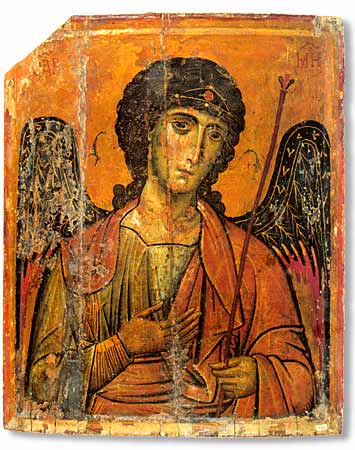
Jehovah's Witnesses teach that Jesus Christ was once Michael the archangel, before becoming flesh during the first century.[1] In the Bible, Michael appears in the book of Daniel, and is referenced in the New Testament books of Jude and Revelation. The name "Jesus" appears approximately 900 times in the Greek New Testament - six of these in Jude, and fourteen of these in the book of Revelation.[2] This numbering does not include for the many times "Lord," "Christ," "Son of Man," "Son of God," or "Son of David," among other titles, are used of Jesus. Suffice to say, the archangel Michael is referenced three times in Daniel, once in Jude, and once in Revelation. The Seventh Day Adventist church also teaches that Jesus is Michael the archangel, though a bit different from Jehovah's Witnesses teaching in that Adventists still believe that Jesus has been God for eternity. Does this claim agree with what the Bible teaches? (Photo credit: Michael the archangel, from the Monastery of St. Catherine at Sinai, dated from the 13th century) 

Just as St. Paul writes in 2nd Timothy 3:16, "All Scripture is God-breathed and is useful for teaching, rebuking, correcting and training in righteousness" (TNIV). As such, if a denomination and cult taught that Jesus was Michael, against the express teaching of God's Word, it ought to be examined, rebuked, and corrected. This article will address the question of Jesus' relation to Michael the archangel, and is not intended to address every doctrine and aspect of Seventh Day Adventists and Jehovah's Witnesses. Ellen G. White (1827-1915), who formed the Seventh Day Adventist church, taught that "Moses passed through death, but Michael came down and gave him life before his body had seen corruption. Satan tried to hold the body, claiming it as his; but Michael resurrected Moses and took him to heaven. Satan railed bitterly against God...but Christ did not rebuke His adversary... He meekly referred him to His Father, saying, 'The Lord rebuke thee.'"[3]

White also conveyed, "When Jesus stands up; when his work is finished in the Most Holy, then there will be not another ray of light to be imparted to the sinner....The light is made to reach far ahead, where all is total darkness. MICHAEL stands up."[4] "As Christ and the angels approached the grave, Satan and his angels appeared at the grave, and were guarding the body of Moses, lest it should be removed. As Christ and his angels drew nigh, Satan resisted their approach, but was compelled, by the glory and power of Christ and his angels to fall back. Satan claimed the body of Moses, because of his one transgression; but Christ meekly referred him o his Father, saying, 'The Lord rebuke thee.'"[5] "Just before going into the meeting, I had a revival of some interesting scenes which had passed before me in vision...It seemed to me that the angels were making a rift in the cloud and letting in the beams of light from heaven. The subject that was presented so strikingly was the case of Moses....The angels buried him, but the Son of God soon came down and raised him from the dead and took him to heaven."[6] "As a people we must stand as did the world's Redeemer. When in controversy with Satan, in regard to the body of Moses, Christ durst not bring against him a railing accusation."[7]

Essentially, this is in reference to Jude 1:9, which says, "But Michael the archangel, when he disputed with the devil and argued about the body of Moses, did not dare pronounce against him a railing judgment, but said, 'The Lord rebuke you.'" As for the Jehovah's Witnesses teaching, Watchtower teaches that "The foremost angel, both in power and authority, is the archangel, Jesus Christ, also called Michael."[8] Evidently, both the Seventh Day Adventist Church and the Jehovah's Witnesses teach that Jesus is (or was) Michael the archangel. The Witnesses believe that Christ is the incarnate Michael. They believe that Jesus was the first creation of God, and that Jesus made "other things" in creation, but not "all things." Along with this, they teach that when Jesus returns, it will be as Michael. Before we continue, however, it is necessary to establish what "angel" means.

In Hebrew, the word for angel is mal'ak, meaning a "messenger, representative, an angel" (BLB Lexicon), or "one sent, [as in] a messenger" (Gesenius's Lexicon). The Greek word for angel is aggelos, meaning "a messenger, envoy, one who is sent, an angel, a messenger from God." In the context of Michael the archangel, however, we are referring not to an earthly, human messenger as in the "angel of the church of Ephesus" (Revelation 2:1) or as in "the angel of the church of Sardis" (Revelation 3:1), but as in a heavenly being, such as those described in Ezekiel 1 and Revelation 4. A description of a heavenly angel, which generally comes to mind when someone is speaking of angels, can be found in Hebrews 1:7, "In speaking of the angels he says, 'He makes his angels spirits, and his servants flames of fire,'" as well as Hebrews 1:14, "Are not all angels ministering spirits sent to serve those who will inherit salvation?" With this knowledge in mind, we can further examine aforementioned claims about the relation between Jesus and Michael.

Philippians 2:6-7 declares, "[Jesus,] Who, being in very nature God, did not consider equality with God something to be used to his own advantage, rather, he made himself nothing by taking the very nature [or form] of a servant, being made in human likeness." Jesus "took the form of a servant," and as such, was not a servant prior to His birth in Bethlehem. This is because an angel is a servant, according to Hebrews 1:7, 14. This is one demonstration of the fact that Jesus is not an angel, nor was He. He took on the nature or form of a servant, He was not a servant prior to His birth. In regard to the Jude 9 text, note that Michael is probably the head of the angels, hence his title as "archangel" (some suggest that Satan was once head of the angels before his fall), a title which is attributed only to Michael in the Bible. He is, however, merely an angel, and not God. In Matthew 4:10, Jesus rebuked Satan by his own authority, whereas in Jude 9, we read that Michael "did not himself dare to condemn him for slander but said, 'The Lord rebuke you.'" Jesus was surely not afraid to rebuke Satan, but Michael was. Clearly, Jesus was more authority than Michael, if nothing else. Jesus also rebuked Satan in Matthew 16:23.

Some may argue that Jesus did not attain authority until after His resurrection, because He says in Matthew 28:18, "All authority on heaven and earth has been given to me." This is an inaccurate claim, however, because Jesus rebuked the devil long before His crucifixion and subsequent resurrection. If Michael and Jesus were the same being, why did Michael defer to the Lord? Romans 10:9 says that "Jesus is Lord," along with Philippians 2:11, "Jesus Christ is Lord," along with several other references. St. Paul calls Jesus, "Lord," numerous times, such as in Romans 1:4, "Jesus Christ our Lord," in 1st Corinthians 1:3, He is called the "Lord Jesus Christ," as well as throughout St. Paul's letters. James also called Jesus "the Lord Jesus Christ" (James 1:1), along with St. Peter, who calls Him "our Lord and Savior Jesus Christ" (2nd Peter 3:18). John also calls him the "Lord Jesus" (Revelation 22:21).

Significantly, Jude calls Jesus "Jesus Christ our only Sovereign and Lord" (Jude 4), yet Jude does not call Michael "Lord," but relays the account of Michael, who defers to the Lord. Not once in Scripture is Michael called Lord, or Michael called Jesus. If Michael were Jesus, why are both mentioned in Jude with a distinction made, and why do both appear in Revelation? To be clear, Jesus Himself claimed to be "Lord" on more than one occasion (see John 13:13, for example), yet Michael did not. It is true that "Lord" can also mean a master or ruler, but evidently, the Bible is clear that Jesus is more than a mere master - He is also called God. However, Michael is called neither Lord nor God. Daniel 10:13 calls Michael "one of the chief princes," Jude 9 calls Michael "the archangel," and the reference in Revelation 12:7 says, "...Michael and his angels fought against the dragon, and the dragon and his angels fought back."

Taken as a whole, canonical Scripture sees Jesus is Lord and God, whereas Michael is the archangel, and not God. Jesus is called God (Isaiah 9:6; John 1:1-3, 14, 18; 10:33; 20:28; Colossians 1, 2:9; Philippians 2; Hebrews 1, etc.), Jesus claimed to be God (John 10:30, 13:19, 14:8-11, etc.), and even the Father calls Jesus, "God" (Hebrews 1:8). Nehemiah 9:6 says, "You alone are Lord." 1st Kings 8:60 says, "the LORD is God [and] there is no other," along with Isaiah 45:5, which says "I am the LORD, and there is no other" (see also 45:6, 18; Ephesians 4:5, etc). When Jesus returns in Revelation 19:16, on his robe and thigh is written the name "KING OF KINGS AND LORD OF LORDS." God's Word is also clear that there is one God. Yet Jesus, the Father, and the Holy Spirit, are all called God. Isaiah 43:10 is clear that no god was formed before God, nor will there be one after Him - He is eternal. This monotheistic concept is seen throughout both Testaments. In fact, another point to consider is worship. Though Michael is a powerful being, he is not to be worshiped. 

Hebrews 1:6 says, referring to Jesus and quoting 2nd Samuel 7:14 and 1st Chronicles 17:13, "Let all God's angels worship Him." This can also be seen in Revelation 19:10 and 22:8-9, where John bows to the heavenly messenger, who in response says, "Don't do that! I am a fellow servant with you and with your brothers who hold to Jesus' testimony. Worship God! For the testimony of Jesus is the Spirit of prophecy." St. Paul calls the "worship of angels... unspiritual" (Colossians 2:18). Surely, then, we are not to worship angels. However, Jesus is to be worshiped. Jesus said to worship God alone (Matthew 4:10), and yet Jesus is worshiped, in Matthew 2:2 and 11, 14:33, 28:9; John 9:35-38, 20:28, Philippians 2:10-11, and Hebrews 1:6. Hebrews 2:5 states, "It is not to angels that he has subjected the world to come, about which we are speaking," and 2:9 says, "But we do see Jesus, who was made lower than the angels for a little while, now crowned with glory and honor because He suffered death, so that by the grace of God He might taste death for everyone." Hebrews 2 teaches that God has not subjected the world to come to the rule of angels, but to Jesus. This demonstrates that Jesus is not, nor was He, an angel.

Jehovah's Witnesses claim that 1st Thessalonians 4:6 supports their position, which says, "For the Lord himself will come down from heaven, with a loud command, with the voice of the archangel and with the trumpet call of God, and the dead in Christ shall rise first." Since the verse has the phrase, "with the voice of the archangel," this allegedly supports the position that Jesus is Michael. In actuality, the verse teaches that when the Lord descends from heaven, it will be the archangel, in his own voice, who accompanies him. Those who hold to this doctrine will also have to answer Daniel 10:13, which, as noted earlier, calls Michael the "one of the chief princes." Does this mean that Jesus has equals in heaven that are angels? What would their names be?

According to The King Messiah Project, "the Jehovah’s Witnesses think that Jesus will return as the archangel Michael. Keeping this in mind, Revelation 19:11-12 describes the Second Coming of Jesus Christ. Will He be coming as Michael? Not according to verse 12, which states that 'he had a name written, that no man knew, but he himself:' 'And I saw heaven opened, and behold a white horse; and he that sat upon him was called Faithful and True, and in righteousness he doth judge and make war. (12) His eyes were as a flame of fire, and on his head were many crowns; and he had a name written, that no man knew, but he himself.' Since Revelation 19:12 teaches that Jesus will have 'a name written, that no man knew, but he himself,' the Jehovah’s Witnesses must be incorrect by thinking that Jesus is Michael. After all, according to this verse, Jesus cannot be Michael because nobody will know His true name at His Second Coming."[9] 

From the Monastery of St. Catherine, Sinai (1200's)
It should be noted that in the Hebrew Bible, when Jesus Christ appeared as God manifested, it was as the "angel of the Lord," but not as Michael. The angel of the Lord, or rather messenger or representative of the Lord, claimed to be God (Exodus 3), and claimed to be the one who led the Israelites out of Egypt (Judges 2:1-4). In some early manuscripts, Jude 5 read, "Though you already know all this, I want to remind you that Jesus at one time delivered his people out of Egypt, but later destroyed those who did not believe." Also, Jesus claimed more than once to be the "I AM" who appeared to Moses in the burning bush (see John 8:58). This messenger of God is also called God by Manoah and his wife (Judges 13:22). Exodus 33:20-23 and John 1:18 make clear that the Father cannot be seen (unless you are in heaven, as is the case in Isaiah 6 and Daniel 7), but God appears physically several times in the Hebrew Bible. The "messenger of the Lord" is further explained and examined in articles such as, "Who Is 'The Angel of the Lord?'" and "The Holy Trinity (Part Two)," but when God physically manifested in the Hebrew Bible, it was usually God the Son, who is Jesus. There is a clear distinction between this messenger of the Lord and Michael, as Michael never claimed to be God and is never called God. Michael and the Messenger of the Lord are not the same being, as Jehovah's Witnesses contend.

The author of Hebrews, which was likely written c.62-68 AD, seemed to have been attempting to relay Jesus' divine nature. In Hebrews 1:4-14 we read, "So he became as much superior to the angels as the name he has inherited is superior to theirs. For to which of the angels did God ever say, 'You are my Son, today I have become your Father'? Or again, 'I will be his Father, and he will be my Son'? And again, when God brings forth his firstborn into the world, he says, 'Let all God's angels worship him.' In speaking of the angels he says, 'He makes his angels spirits, and his servants flames of fire.' But about the Son he says, 'Your throne, O God, will last for ever and ever; a scepter of justice will be the scepter of your kingdom. You have loved righteousness and hated wickedness; therefore God, your God, has set you above your companions by anointing you with the oil of joy.' He also says, 'In the beginning, Lord, you laid the foundations of the earth, and the heavens are the work of your hands. They will perish, but you remain; they will all wear out like a garment. You will roll them up like a robe; like a garment they will be changed. But you remain the same, and your years will never end.' To which of the angels did God ever say, 'Sit at my right hand [a position of authority] until I make your enemies a footstool for your feet?' Are not all angels ministering spirits sent to serve those who will inherit salvation?"

From the above text, it is clear that Jesus is not an angel. In the New World Translation of the Bible, which the Jehovah's Witnesses use, many of the verses cited in this article may be different. The NWT of the Bible is an inaccurate translation, and noticeably, when verses are found which contradict a particular Witness doctrine, that verse is changed, and a new edition of the New World Translation is published. We cannot pick and choose what to accept from Scripture. Allow Scripture to speak for itself, and it speaks of Jesus as Lord and God. Change it to fit your doctrine, and it speaks of Jesus as Michael. This is a fallacious and unjustified way to handle God's Word. Phrases, such as in Colossians 1:16, are inserted into the NWT. Also, indefinite articles, such as in John 1:1 are added to make it seem as if Jesus is merely "a god," and not "God" - yet three verses later, they translate the same phrase as "God." "A" or "an" is not an indefinite article in the Greek, so it must be added by the translator. There are no textual grounds for their tampering of Scripture, only theological. A committee of anonymous editors has put forth the New World Translation, and this gives little credence to their claim of authenticity. There are several other inconsistencies and problems with this translation.

One last consideration: we also need to account for the fact that "Jesus Christ is the same yesterday and today and forever" (Hebrews 13:8), and as God, does not change (Malachi 3:6; Numbers 23:19; 1 Samuel 15:29; Isaiah 46:9-11; Ezekiel 24:14). If Jesus was once Michael or is Michael, then we would have to account for these passages. Jesus is Lord and God (John 20:28; Titus 2:13; 2nd Peter 1:1), and is uncreated, and eternal, whereas Michael the archangel is a created being, and had a beginning. Since all Scripture is useful for rebuking and correction, we can stand firm upon God's Word and make the determination that Jesus is God, and not Michael the archangel, as taught by Jehovah's Witnesses and Seventh Day Adventists, though the teachings of the Seventh Day Adventist differ from the Witnesses view of God, for you see, Seventh Day Adventists teach that "Michael" is simply another name for Jesus. Yet what has been written in this article applies to that teaching as well. The Jehovah's Witnesses have similar teachings to Arianism, a heretical group in the fourth century AD which taught that Jesus is not equal in nature to the Father, but is a created being. Other teachings of Arianism are found within Jehovah's Witness doctrine (For further information about Arianism and its influence, see here). Therefore, is Jesus Christ the same as Michael the archangel? We hold that Jesus is not the same as Michael, but that Jesus is God, and is separate from Michael, who is simply the archangel. 

Troy Hillman

Sources
[1] The Watchtower, May 15, 1963, p. 307; The New World, 284. 
[2] Slick, Matt. "Is Jesus' name really Yeshua?." Christian Apologetics & Research Ministry. Christian Apologetics and Research Ministry, n.d. Web. 15 Oct 2011.
[3] Early Writings, p. 164
[4] Spiritual Gifts, vol. 2, p. 276
[5] Spiritual Gifts, vol. 4a, p. 58
[6] Testimonies for the Church, vol. 1, p. 659
[7] Testimonies for the Church, vol. 9, p. 239.
[8] The Watchtower, November 1, 1995, p. 8
[9] "Is Jesus Michael the Archangel?." The King Messiah Project. The King Messiah Project, October 2003. Web. 15 Oct 2011.

Saturday, September 24

Does The Bible Contain Intentional Humor?

The average human body can see, taste, touch, smell, and hear. We may utilize one sense at a time, or we may use all five senses at once. Psychologists continue to learn more and more about the human brain, which is part of the central nervous system, and other parts of the nervous system. Other scientists continue to discover more and more complexities in the human body, in nature, in outer space, and in our everyday lives. Many of the readers have probably heard the old saying, "Laughter is the best medicine," which is derived from the Proverbs 17:22 previously mentioned. Perhaps the question that should first be asked is not whether or not the Bible contains humor, but whether or not God has a sense of humor. Consider Jesus in the canonical New Testament: he may weep, but we only find references to Jesus laughing in apocryphal literature (such as the Gospel of Judas). Why this striking omission? Was the accepted Biblical canon simply against humor? 

It is important to determine which type of humor we speak of. There is a type of humor which the world laughs at, which involves laughing at crude humor, and there is a type of humor which involves bringing others down or picking on others - all of which is contrary to Christian ethic (Colossians 3:8, 4:6; Ephesians 4:29; James 1:26). God demonstrates his sense of humor in such instances as when the Philistines captured the ark of the covenant. In 1st Samuel 5:1-5, we read, "After the Philistines had captured the ark of God, they took it from Ebenezer to Ashdod. Then they carried the ark into Dagon's temple and set it beside Dagon. When the people of Ashdod rose early the next day, there was Dagon, fallen on his face on the ground before the ark of the LORD! They took Dagon and put him back in his place. But the following morning when they rose, there was Dagon, fallen on his face on the ground before the ark of the LORD! His head and hands had been broken off and were lying on the threshold; only his body remained. That is why to this day neither the priests of Dagon nor any others who enter Dagon's temple at Ashdod step on the threshold."

Psalm 59:7-9 and Psalm 2:4 also record God laughing, indicating that He does indeed laugh - and the fact that He made us with a sense of humor indicates that He also has a sense of humor. With the knowledge that God has a sense of humor, could it be that He included humor in the Bible, apart from the instance in 1st Samuel? It is important to recognize that God's Word was given to us for a myriad of reasons, the main reason being that it describes God's plan of redemption for mankind from the very beginning, the salvation we can have through God manifested in the flesh as Jesus Christ. There are many historical references, scientific references, along with a plethora of other such things, it would not be unlikely to also find references to humor. The Bible does not hold back - it describes the lives of people who once lived, such as Adam, Noah, Abraham, Moses, King David, King Solomon, Jonah, St. Peter, St. Paul, and many others. Looking at mistakes made by those who lived in Bible times enables us to not make similar mistakes, which is another reason there are a great many accounts found in Scripture, along with a great many other uses and reasons which God gave us His Word.

Having listened to his friends, who were accusing Job of being punished for sin, but indeed was actually being tested (Job 1-2), we read in Job 13:5, "If only you would be altogether silent! For you, that would be wisdom!" Reading on, after a back and forth between Job and his friends for many chapters, God Himself speaks "out of the storm" and proceeds to ask Job a series of questions which Job could not possibly answer. God retorts, "Surely you know, for your were already born! You have lived so many years!" (Job 38:21). When God was manifested in the flesh, He often spoke in parables, which we find recorded in the Gospels. Though it is often missed, Jesus inserted humor into His parables, which probably had his audience roaring with laughter in some cases. Take the parable found in Luke 11:5-7, for example:

"Then Jesus said to them, 'Suppose you have a friend, and you go to him at midnight and say, 'Friend, lend me three loaves of bread; a friend of mine on a journey has come to me, and I have nothing to set before him.' And suppose the one inside answers, 'Don't bother me. The door is already locked, and my children and I are in bed. I can't get up and give you anything.'" In this parable, Jesus' first century audience likely understood that the man's dog, sheep, goats, and the like would be kept inside the house with him. As such, His audience can imagine the back-and-forth between the two people waking the entire household, including the animals and the children - a scene of hilarity. Yet another example involves Genesis 6-9. Noah was commissioned by God to build the Ark - a lifeboat - to save the human race and the animal population (the sea creatures did not need to be on the Ark, as it was a flood). In this instance, we recall, Noah must have been a brave man, living on a ship for several months - built out of wood - which probably contained two termites and woodpeckers.

In Acts 12, we read that King Herod had Peter arrested for his continual preaching of Christianity. The church was praying to God concerning Peter (v.5), and while Peter was sleeping between two soldiers, "Suddenly an angel of the Lord appeared and a light shone in the cell. He struck Peter on the side and woke him up. 'Quick, get up!' he said, and the chains fell off Peter's wrists" (v.7). At first, Peter believed it to be a vision, and followed the angel out of the prison, when the angel then left him. He then realized he was not in a vision, but that a miracle had occurred. "When this had dawned on him, he went to the house of Mary the mother of John, also called Mark, where many people had gathered and were praying. Peter knocked at the outer entrance, and a servant named Rhoda came to answer the door. When she recognized Peter's voice, she was so overjoyed she ran back without opening it and exclaimed, 'Peter is at the door!' 'You're out of your mind,' they told her. When she kept insisting that it was so, they said, 'It must be his angel.' But Peter kept on knocking, and when they opened the door and saw him, they were astonished." Peter, having escaped prison, went to Mark's household (who wrote the third gospel, Mark), where a servant answered the door, and much like in a sitcom, a scene ensues wherein Peter is left waiting while the occupants discuss who it could be - until they finally realize that the solution to see who it is, is simply to open the door.

Two examples are found in Matthew 28. After the angel appears to roll away the tombstone of where Jesus lay, "The guards were so afraid of him that they shook and became like dead men" (they fainted, v.4). However, when the women come upon the empty tomb, women who had been weeping and were in low spirits, Matthew 28:5 records, "The angel said to the women..." and the women listened to what the angel had to say. It is interesting that the guards, who had been battle-trained, and were "tough" men, fainted... yet the women did not. Another point to ponder involves what happened after the soldiers awoke. Some of the guards went into the city and told the chief priests what had happened. The priests "devised a plan, [and] they gave the soldiers a large sum of money, telling them, 'You are to say, 'His disciples came during the night and stole him away while we are asleep'" (v.12-13). If the soldiers were sleeping, how could they have known who stole the body?

The Bible is replete with humorous references, especially in the Hebrew and Greek. The witticism, idioms and hyperboles come across more when read in their original language then in some English translations. As aforementioned, while Jesus taught many serious things, His teachings were not without humor. According to Reverend Peter Weatherby, "Jesus has a particular eye for the ironical and paradoxical. He gave His disciples nicknames: Peter the Rock who was big on words, but a coward when it mattered; James and John, hotheads, were 'Sons of Thunder'. He told stories about judges who gave justice only after being pestered repeatedly, businessmen who amassed riches only to die the next day, and about priests too precious to help a man who had been beaten up. He talked about people who gave stones in the place of bread, and saw the speck in the eye of another but ignored the log in their own eye. He talked about the blind leading the blind. He called the holy men of his day whitewashed walls." Consider Matthew 23:24, for example, in which Jesus says, "You blind guides! You strain out a gnat but swallow a camel." Here, Jesus essentially says, "you are like someone who has strained a fly from his cup but has swallowed a camel!" Jesus, no doubt, "told them how he really feels." 

There is also a reference in Matthew 7:3 which says, "Why do you look at the speck of sawdust in someone else's eye and pay no attention to the plank in your own eye? How can you say, 'Let me take the speck out of your eye,' when all the time there is a plank in your own eye?" Other examples are found all throughout Scripture. For instance, in Genesis 17:17, after God tells Abraham that he will have a son with Sarah, we read that "Abraham fell facedown; he laughed and said to himself: 'Will a son be born to a man a hundred years old? Will Sarah bear a child at the age of ninety?'" God, who knows the thoughts of our mind (Psalm 94:11), evidently was not the happiest with Abraham for his unbelief that through Him this would be impossible, and told Abraham to name his son, "Isaac," which means "he laughs," because Abraham found it funny that he, at the age of 100, would have a son.

We can imagine the smiles and laughs within the actual event found in John 1:45-51, "Philip found Nathanael and said unto him, 'We have found the one Moses wrote about in the Law, and about whom the prophets also wrote - Jesus of Nazareth, the son of Joseph.' 'Nazareth! Can anything good come from there?' Nathanael asked. 'Come and see," said Philip. When Jesus saw Nathanael approaching, he said of him, 'Here truly is an Israelite in whom there is no deceit.' 'How do you know me?' Nathanael asked. Jesus answered, 'I saw you while you were still under the fig tree before Philip called you.' Then Nathanael declared, "Rabbi, you are the Son of God; you are the king of Israel.' Jesus said, 'You believe because I told you I saw you under the fig tree. You will see greater things than that.' He then added, 'Very truly I tell you, you will see 'heaven open, and the angels of God ascending and descending on' the Son of Man.'" 

1st Kings 18:20-39 records the "battle of the gods," if you will. The prophets of Baal and Elijah compete to determine which god is the true God. In 1st Kings 18:27 we read, "It came about at noon, that Elijah mocked them and said, 'Call out with a loud voice, for he is a god; either he is occupied or gone aside, or is on a journey, or perhaps he is asleep and needs to be awakened.'" (NASB) The phrase translated as "gone aside" is the Hebrew word סיג (ciyg), which comes from the root word סוג (cuwg) meaning "refuse." Essentially, Elijah was saying, "Call out for your god; either he is going to the bathroom, is taking a walk, or maybe he is asleep!" The wit of Elijah, along with many others, can sometimes be "lost in translation." The Bible has been accurately preserved, but it helps to own a Hebrew and Greek lexicon to determine what certain words can be translated as to get an overall better understanding of a passage. 

Surely, the Bible contains many humorous references, and certainly studies have been done of the various witticism, hyperbole, and idioms present in the Greek and Hebrew, along with more in-depth looks at the many instances which can be called humorous. Laughter is good, as a "cheerful heart is good medicine..." (Proverbs 17:22). .Does the Bible contain humor? It certainly does.

Troy Hillman