Showing posts with label Qur'an. Show all posts

Tuesday, September 23

Apocryphal Horror in Film: The Carpenter's Son with Nicolas Cage

A horror film about Jesus? A few weeks ago, a teaser trailer for an upcoming Fall film, The Carpenter's Son, was released. While the trailer gives away little in the way of story, the material drawn on for this flick has a very long and rich history. The film itself was announced in Spring 2024, with the news that Nicolas Cage, FKA Twigs, Noah Jupe, and Souheila Yacoub would star, and that the movie would explore "the rarely told story of the childhood of Jesus with a horror take."[1] Where would this "rarely told story" originate? Matthew's gospel only covers the first couple years of Jesus' life, from his birth to the flight to Egypt, then return to Israel. Luke's gospel covers his birth, then jumps to Jesus in the Temple at age twelve. Where, then, would such a story derive from, particularly material which could be used for a horror film? Before discussing the film itself, a few paragraphs should be dedicated to the history of Infancy traditions about Jesus. Consider the following quote from an early Christian text: 

"When this child Jesus was five years old.... he was going through the village, and a child ran up and banged into his shoulder. Jesus was aggravated and said to him, 'You will go no further on your way.' And right away the child fell down and died.... The parents of the dead child came to Joseph and blamed him, saying 'Since you have such a child you cannot live with us in the village. Or teach him to bless and not to curse—for he is killing our children!'”[2] 

What kind of Jesus is this? At first glance, this may strike readers as shocking, and seemingly at odds with the Jesus of the four canonical gospels. Where does this come from? In early Christianity, narrative gaps in circulating stories of Jesus sometimes led to the development of apocryphal texts, which filled in those gaps. The Infancy Gospel of Thomas (hereafter IGT), quoted above, is our earliest known apocryphal writing concerning the child Jesus, starting at age 5 and ending in the Temple at age 12. There are ongoing discussions among scholars as to the purpose of this text, as well as its provenance, textual history, and development over the centuries. While this post does not have the space to wade through these nuances, IGT has been covered by several scholars in recent decades, and appears to be a growing interest in academia.[3]

The debt the film owes to IGT is directly acknowledged from its initial announcement onward.
[4] There are several variations of IGT over the centuries in terms of length, content, and language, but some of the more common stories / episodes from the text include a young Jesus molding birds out of clay, which come to life (perhaps echoing God's forming of Adam), multiple stories of Jesus (quite literally) schooling his Jewish instructors with his advanced knowledge (paralleled in other apocryphal works, such as the Epistle to the Apostles), a story of a boy falling off a roof and dying, only to be brought back by child Jesus to prove to the parents that Jesus had not pushed him off, another story of Jesus extending a piece of wood for Joseph that had been cut too short, and another story of Jesus carrying water in his cloak for Mary. The narrative arc of the text sees Jesus going from cursing (be it other children, townspeople, or his rabbinical teachers) to blessing and healing, again, culminating with the story from Luke's gospel of Jesus at age 12 in the Temple. The story quoted above of the child who bumps into Jesus typically appears early in the IGT manuscripts. While there are other stories that come to be associated with this tradition, many of these appear to be the core tales.  

It is worth noting that The Carpenter's Son (hereafter TCS) is not the first time elements of the apocryphal text have been adapted for film in recent years: readers may recall the 2016 film The Young Messiah, which tells the story of a young boy Jesus in Egypt with Mary and Joseph, while he wrestles with his identity and his developing abilities. Brief spoilers for the first few minutes of that film follow: the above-quoted story is adapted, but instead of depicting Jesus cursing and killing the child who bumps into him, the boy's death is attributed to Satan (whom only Jesus can see), who makes the boy trip and fall on a fruit in the street. There is also a scene in which Jesus brings to life a bird on the beach that has died (echoing the clay birds story), as well as a scene where Jesus essentially teaches his teacher in Alexandria, again echoing elements from IGT. The film was based on the 2005 novel by Anne Rice (of Vampire Chronicles fame), Christ the Lord: Out of Egypt, which Rice acknowledges was itself inspired in part by IGT.
[5]

While Rice and Young Messiah tended to adapt the IGT stories of Jesus cursing in a way that shifted blame to Satan, TCS will likely lean into these elements to highlight the horror. Some may recall the 2019 film Brightburn, which took the idea of Superman (a figure like him, not the character specifically), who is normally depicted as a hero or savior who uses his powers for good, and flipped the story on its head: film posters had a tagline that emphasized, "HE'S NOT HERE TO SAVE THE WORLD."
[6] The upcoming TCS film sounds and looks like it will be taking a similar approach. To be fair, this is not the first film to depict horror in connection with the life of Jesus; we may argue that Mel Gibson's Passion of the Christ could classify as horror (including, beyond the graphic death of Jesus, demonic jump-scares and horrific glimpses of Satan). We may also argue that The Last Temptation of Christ contains horror elements, such as (spoiler!) the scene in which Jesus rips the heart out of his chest and holds it in his hands.

What makes TCS different, and what aspects of the film will mark it as "horror?" For your patience, dear reader, here now is the film's official synopsis: "The Carpenter’s Son tells the dark story of a family hiding out in Roman Egypt. The son, known only as ‘the Boy’, is driven to doubt by another mysterious child and rebels against his guardian, the Carpenter, revealing inherent powers and a fate beyond his comprehension. As he exercises his own power, the Boy and his family become the target of horrors, natural and divine."
[7] Filmed in Greece, the aforementioned cast will include Cage, "playing the Carpenter, FKA Twigs will be playing the Mother, and the young Noah Jupe (most recently seen in A Quiet Place, Part II) will be playing the role of The Boy."[8] Whether Joseph, Mary, and Jesus will be explicitly referred to by name is unknown. At the end of August 2025, the first teaser was released, and by early September, the film was rated R for "strong/bloody violent content, and brief nudity," without elaboration.[9] Even before this, the film had drawn some criticism from religious circles from its initial announcement onward.[10]

Why am I covering this film here? For three reasons. First, as the title of the blog indicates, my academic work and research involves early Christian writings, especially apocryphal texts from the 2nd century onward, in conversation with the New Testament canon as well as other forms of material culture that tell us about the ways Christianity (or early "Christianities") changed and developed in Late Antiquity and beyond. I was first introduced to the IGT text almost two decades ago by Bart D. Ehrman's Lost Scriptures, which contained excerpts (and in some cases full texts) of early apocryphal writings. My intention with this post, this blog, and my own work is not to offend or attack persons of faith (I myself hold a Christian background and continue to be a practicing Christian alongside my work as an academic), but rather to use all forms of available materials: textual, archaeological, and otherwise, to elucidate the lives of early Christians.

Second, I am interested in the ways in which apocrypha has been adapted and used over the centuries in a variety of contexts. Interestingly, the Infancy stories that began in IGT traditions made their way into Islamic and Jewish texts from early on; a story of Jesus bringing clay birds to life from IGT, as well as stories of Mary known from another apocryphal text, the Protoevangelium of James (or Infancy Gospel of James), end up in chapters of the Qur'an, as well as in a medieval Jewish text, the Toledot Yeshu, which contains related material.
[11] IGT was so popular from early Christianity onward that it grew, was edited, adapted, and took on new stories and expansions in the form of the Gospel of Pseudo-Matthew, the Syriac Infancy Gospel, the History of Joseph the Carpenter, Arabic Infancy Gospel, the Life of John the Baptist, and other Infancy texts from Late Antiquity on. Christian artwork over the centuries has also depicted scenes from the various Infancy traditions.

Even still today, as evidenced by this upcoming film as well as Rice's book and its 2016 adaptation, Young Messiah, the traditions are still clearly being discussed, adapted, and expanded. For a person of faith concerned about the film or the ancient text, one need not accept IGT as "Biblically accurate" to study the ways in which apocryphal stories have influenced (and clearly continue to influence) culture. It may be interesting to compare and contrast Young Messiah with The Carpenter's Son once the latter has been released.

Third, my other interest in this film is the fact that very few stories from apocryphal texts have been adapted into film (or any media). There was a 1951 film, Quo Vadis, which draws on an episode from the apocryphal Acts of Peter, in which Peter encounters the risen Jesus on the road to Rome, where Peter will be crucified. There is also a short faith-based documentary on the apocryphal Jesus and Abgar correspondence, and a graphic novel that takes partial inspiration from the Harrowing of Hell as portrayed in the Gospel of Nicodemus.
[12] But beyond these, and Young Messiah (which also includes material about Mary from Inf. Gos. Jas.), there are few adaptations of Christian apocrypha. Thus, it is quite a rarity to have two films about a single apocryphal text to compare, in this case, how and in what ways Young Messiah and TCS adapt the same material.

Finally, turning back to TCS itself, for those who are not spoiler-conscious, what does the teaser trailer potentially reveal about the film, and what might it be drawing on for horror material in the IGT tradition? Will TCS just use the concept of the text (which, it should be added, has a variety of translations and editions, and no original manuscript or "autograph") without drawing from any specific stories? From the teaser trailer alone, it is hard to tell. The teaser clocks in at only 20 seconds or so, and we are only given a few glimpses of characters. The teaser shows brief shots of Joseph ("the Carpenter") in the desert, a grieving Mary ("the mother") being comforted by three other women, and what appears to be a demon or a possessed person crying out near Joseph. Inter-cut with these shots are a couple shots of a shrouded body, which itself cries out. Beyond this, the trailer reveals little.

In the process of writing this piece, however, a second teaser trailer was released. A few seconds longer than the first, it includes several of the same shots, in addition to a scene of Joseph crying out next to a donkey and a body lying face-down (wearing blue and white), a shot of what appears to be the "other boy" (evidently the film's version of Satan) influencing Jesus near a small body of water (who turns toward the camera while a snake emerges from his mouth), a shot of Roman crosses, a red sky, a mass of twisting bodies reminiscent of a scene out of Dante's Inferno, the "other boy" hitting Joseph, a crown of thorns laid at the feet of the shrouded body, and more shots from the first trailer. We do get some narration in this trailer, too. Cage says, "Pray. Find the strength to bear against Satan." A male voice (presumably Jesus) asks, "What does Satan look like?" Joseph answers, "Like people amongst us." The boy responds, "Have you ever seen it?", ending with the demon(?) wailing at Joseph.

While the trailer does not appear to depict any specific moments from IGT, the teasers and the plot summary do provide some hints at the film's trajectory. The film's summary describes it as being set while the family is "hiding out in Roman Egypt," which aligns with the context of IGT. The summary further describes another "mysterious child" who drives Jesus ("the Boy") to "doubt" as he wrestles with his "inherent powers" in the midst of the family encountering horrors. Unlike Young Messiah and TCS, Satan does not appear in IGT, nor do demons or visions, but the upcoming film appears to be bringing in those elements to further the "horror take." What the teasers also seem to show is Joseph receiving visions of Jesus' future (or perhaps Satan tempting young Jesus with visions) in the form of the burial shroud, the crown of thorns, and a grieving Mary. Unlike Brightburn, where the Superman-like figure uses his powers against humanity, Jesus in these trailers does not (yet) appear to be using his abilities for ill gain. The film may be drawing on the traditional interpretation of Jesus in IGT as a "holy terror" or a "trickster" (an image persuasively argued against by Tony Burke),
[13] but this is unclear from the teasers, in which the horror aspects appear tied more-so to Satan's involvement than Jesus' own actions, but time will tell how the movie handles these elements.

As of mid-late September 2025, TCS does not yet have a firm release date, with trailers only specifying "Fall 2025 A.D.". Sometime after the film's premiere, it may be worth returning to the text to take a closer look at exactly what it adapts from the apocryphal traditions, and perhaps from the canonical New Testament as well. Bear in mind that the burial shroud and crown of thorns, for instance, do not appear in IGT, as they are part of Jesus' later life. Thus, what the teaser trailers appear to show is a blending of the apocryphal with the canonical, as well as common horror elements of films today. Undoubtedly, the film will draw both criticism and praise from a variety of different circles. For the purposes of this blog, however, the interest lies in how the film is using and adapting the Infancy tradition(s), as well as how it furthers the conversations about early Christian texts and early Christianity as a whole. The Jesus of IGT moves from cursing to blessing; will "the Boy" of TCS go and do likewise?

Endnotes
[1] Nathan’s ‘The Carpenter’s Son’; Black Bear Launching Sales On Christian Horror Title At Cannes,” Deadline, May 7, 2024, https://deadline.com/2024/05/nicolas-cage-fka-twigs-noah-jupe-holy-family-lotfy-nathan-the-carpenters-son-1235905229/.
[2] The Infancy Gospel of Thomas 1, 4 in Bart D. Ehrman, Lost Scriptures: Books That Did Not Make It into the New Testament (New York: Oxford University Press, 2003), 58.
[3] See Tony Burke, The Infancy Gospel of Thomas: The Text, its Origins, and its Transmission (PhD diss., University of Toronto, 2001); Tony Burke, De Infantia Iesu Evangelium Thomae Graecae (Turnhout: Brepols, 2010); Mgr. Jeroným Klimeš, “Was Pseudo-Thomas a Child? Psychological Profile of the Author of the Pseudo-Thomas’s Apocryphal Gospel” (Charles University, 2010), https://www.klimes.us/mojeprace/pseudothomas/pseudothomas.pdf; Reidar Aasgaard, The Childhood of Jesus: Decoding the Apocryphal Infancy Gospel of Thomas (Cambridge: James Clarke & Co., 2010); Stephen J. Davis, Christ Child: Cultural Memories of a Young Jesus (New Haven, CT: Yale University Press, 2014); Tony Burke, The Syriac Tradition of the Infancy Gospel of Thomas: A Critical Edition and English Translation (Piscataway, NJ: Gorgias Press, 2017); Jonah Bissell, “School Buildings in Mediterranean Antiquity: Notes on the Provenance of the Infancy Gospel of Thomas,” Journal for the Study of the New Testament 43, no. 3 (2020): 303–320; The Infancy Gospel of Thomas, eds. D. Cielontko, T. Nicklas, and J. N. Bremmer (Leuven: Peeters, 2025).
[4] Grobar, “Nicolas Cage, FKA Twigs, Noah Jupe & Souheila Yacoub To Star.”
[5] Anne Rice, Christ the Lord Out of Egypt: A Novel (New York: Knopf, 2005), 226–27 (PDF).
[6] Brightburn (2019) poster, IMDb, https://www.imdb.com/title/tt7752126/mediaviewer/rm4105201408/?ref_=tt_ov_i.
[7] Grobar, “Nicolas Cage, FKA Twigs, Noah Jupe & Souheila Yacoub To Star.”
[8] Philip Chrysopoulos, “Nicolas Cage’s ‘The Carpenter’s Son’ to Be Filmed in Greece,” Greek Reporter, September 9, 2024, https://greekreporter.com/2024/09/09/nicolas-cage-carpenters-son-greece-filming/.
[9] John Squires, “‘The Carpenter’s Son’ Starring Nicolas Cage Rated ‘R’ for Bloody Violent Content and Nudity,” Bloody Disgusting, September 11, 2024, https://bloody-disgusting.com/movie/3899669/the-carpenters-son-starring-nicolas-cage-rated-r-for-bloody-violent-content-nudity/.
[10] Reddit user u/[username], “The Carpenter’s Son, Regardless of Faith, Is an Incredible Film,” r/movies, September 2025, https://www.reddit.com/r/movies/comments/1ndcjcj/the_carpenters_son_regardless_of_faith_is_an/; Matthew J. Milliner, “Nic Cage’s The Carpenter’s Son: Bible Horror or Blasphemy?” The Bible Artist, September 2025, https://www.thebibleartist.com/post/nic-cage-s-the-carpenter-s-son-bible-horror-or-blasphemy.
[11] See, for instance, Sura 3:49, 5:110, 19:29–34, and elsewhere in the Qur’an. For a rough translation of the Toledot Yeshu, see “Translation: Story of Jesus,” Wikisource, https://en.wikisource.org/wiki/Translation:Story_of_Jesus.
[12] Creative Orthodox, Anastasis: The Harrowing of Hades (North Haven, CT: Creative Orthodox, 2017).
[13] Burke, The Infancy Gospel of Thomas: The Text, its Origins, and its Transmission.

Monday, January 2

Who Was Korah?

According to Ezekiel 28:15, in which Ezekiel is directing a double prophecy against both the King of Tyre and Satan (meaning "the opposer"), in this verse directed at Satan, "You were blameless in your ways from the day you were created till wickedness was found in you" (TNIV). Satan's rebellion against God sparked a chain of rebellion through the ages. His rebellion began when he sought to overthrow God, make himself like God and rule the universe (Isaiah 14:13-14), and when Satan either disguised himself as a serpent or inhabited a serpent (Genesis 3; Revelation 12:9, 20:2) and proceeded to entice and tempt Eve in Eden to eat of the fruit God commanded both her and Adam not to Eve, he sparked the rebellious spirit in mankind. The first two humans disobeyed a direct command of the Creator, corrupting themselves and all of creation as well (Romans 8:20-22), and the rebellion continued with Cain, who was angry that God did not accept his sacrifice (Genesis 4:5-6). Cain responded by committing the first recorded murder (4:8). This rebellious nature is echoed in the generation destroyed by the worldwide flood, as well as afterward when people attempted to disobey God's command to spread throughout the earth, instead building a city and a tower in rebellion (Genesis 11:1-4). In each case, disobedience required justice, and to this day, disobedience toward God still occurs. (Photo credit: The Death of Korah, Dathan and Abiram by Gustave Dore, 1866 - Public Domain usage; Moses and Korah, 1466 - Public Domain usage).

During the time that Moses and the Israelites wandered in the desert (c.1445-1405 BC), more than one rebellion from the people transpired. Notably, one incident stands out among the others. This rebellion was headed by a man named Korah (Hebrew: קֹרַח). Korah, or Kórach, is spelled as Core in some older English translations of the Bible, while several Eastern European translations use Korak. The name itself means baldness, ice, hail, or frost, as explained by Talmudic Rabbis. Korah was the son of Izhar (Exodus 6:21), whose father was Amram, making Korah the cousin of Aaron, Miriam and Moses (Exodus 6:18, 20). There was a Korah who was the son of Esau, and Esau also likely had a grandson named Korah. This Korah, however, is not the Korah who rebelled against Moses. Korah son of Izhar was the great-grandson Levi, who was the third son of Jacob and therefore brother of Joseph, who had been the one to save Egypt from the famine. When the priesthood of Aaron was instituted, Korah and with him 250 men who were well-known community leaders, they came to oppose Moses and Aaron to accuse them (Numbers 16:1-3). 

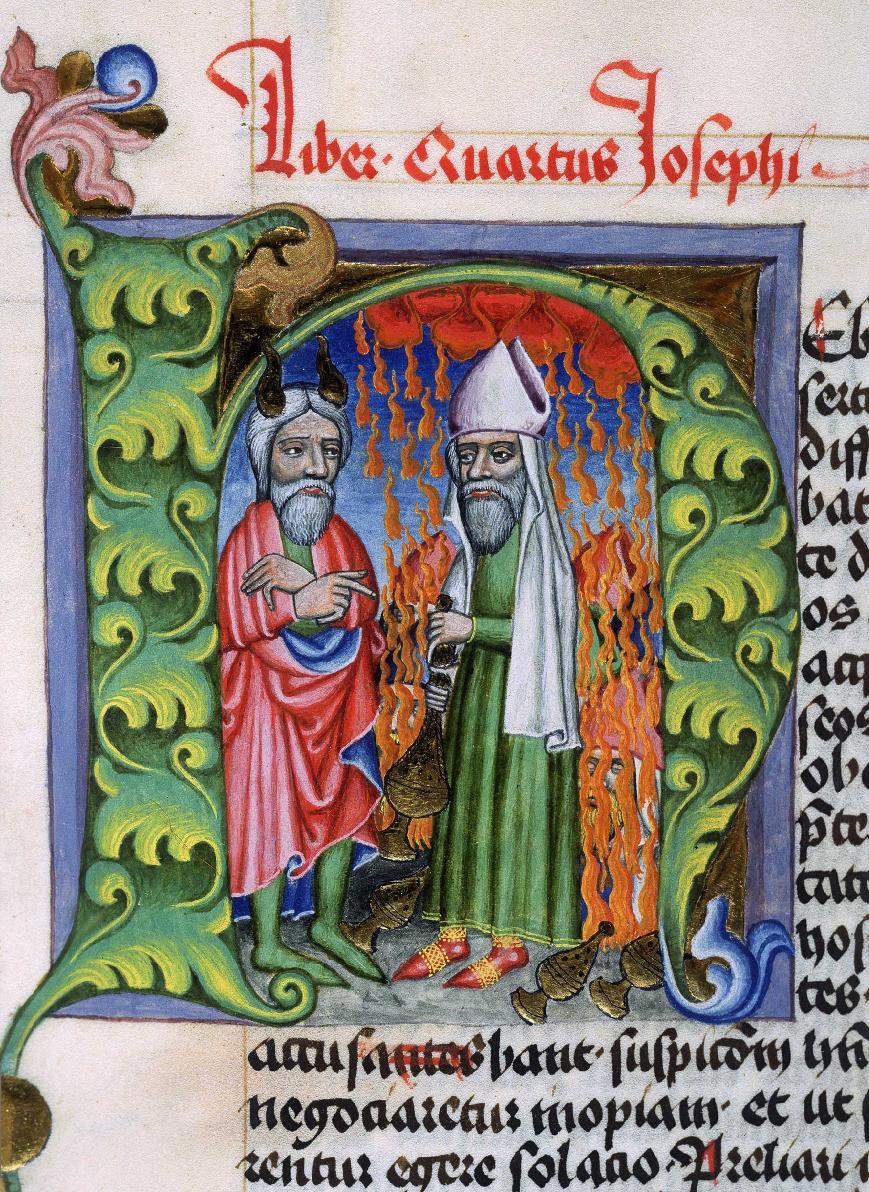
Moses and Aaron's cousin, Korah, did not agree with the priesthood system, particularly with Aaron at its head. Korah, Dathan and Abiram, along with the 250 men, rebelled against Moses and demanded that the former state of everything ought to be restored. Korah said to Moses and Aaron, "You have gone too far! The whole community is holy, every one of them Why then do you set yourselves above the LORD's assembly?" (Numbers 16:3).Moses proceeded to tell Korah and his followers that "In the morning the LORD will show who belongs to him and who is holy, and he will have that person come near him. The one he chooses he will cause to come near him. You, Korah, and all your followers are to do this: Take censers and tomorrow put burning coals and incense in them before the LORD. The man the LORD chooses will be the one who is holy. You Levites have gone to far!" (Numbers 16:5-7). He then said to Korah, "Now listen, you Levites! Isn't it enough for you that the God of Israel has separated you from the rest of the Israelite community and brought you near himself to do the work at the LORD's tabernacle and to stand before the community and minister to them? He has brought you and all your fellow Levites near himself, but now you are trying to get the priesthood too. It is against the LORD that you and all your followers have banded together. Who is Aaron that you should grumble against him?" (Numbers 16:8-11).

Moses attempted to summon the sons of Eliab - Dathan and Abiram, but they said, "We will not come! Isn't it enough that you have brought us up out of a land flowing with milk and honey to kill us in the wilderness? And now you also want to lord it over us? Moreover, you haven't brought us into a land flowing with milk and honey or given us an inheritance of fields and vineyards. Do you want to treat these men like slaves? No, we will not come!" (16:13-14). Moses became angry, crying out to God to not accept their offering. He then spoke to Korah, saying, "You and all your followers are to appear before the LORD tomorrow - you and they and Aaron. Each one is to take his censer and put incense in it - 250 censers in all - and present it before the LORD. You are Aaron are to present your censers also." (16:16-17). The following morning, "each one took his censer, put burning coals and incense into it, and stood with Moses and Aaron at the entrance to the tent of meeting" (16:18). When Korah and his followers had gathered there, "the glory of the LORD appeared to the entire assembly. The LORD said to Moses and Aaron, 'separate yourselves from this assembly so I can put an end to them at once" (16:19-20).

Moses, once again interceding on behalf of the people as he had done many times before, as well as Aaron "fell facedown and cried out, 'O God, God of every human spirit, will you be angry with the entire assembly when only one man sins?' Then the LORD said to Moses, 'Say to the assembly, Move away from the tents of Korah, Dathan and Abiram'" (16:22-23). Moses got up and warned the assembly to move away from the tents of Dathan and Abiram. When they had done so, Dathan and Abiram, with their wives and offspring at the entrance of their tents. "Then Moses said, 'This is how you will know that the LORD sent me to do all these things and that it was not part of my own will: If these men die [naturally] as all people would, and suffer the fate of all, then the LORD has not sent me. But if the LORD brings about something unprecedented, and the ground opens its mouth and swallows them along with all that belongs to them so that they go down alive into Sheol [the realm of the dead], then you will know that these men have despised the LORD" (Numbers 16:28-30; HCSB). The book of Numbers records the incredible event which happened next. 

From Gustave Dore, 1866
"Just as he finished speaking all these words, the ground beneath them split open. The earth opened its mouth and swallowed them and their households, all Korah's people, and all [their] possessions. They went down alive into Sheol with all that belonged to them. The earth closed over them, and they vanished from the assembly. At their cries, all [the people of Israel] who were around them fled because they thought, 'The earth may swallow us too!' Fire also came out from the LORD and consumed the 250 men who were presenting the incense" (Numbers 16:31-35). Eleazar the priest was told to collect the bronze censers brought by those who had been burned to death, and he had them hammered out to overlay the altar, as the LORD directed him through Moses. This was to remind the Israelites that no one except a descendant of Aaron should come to burn incense before the LORD, or he would become like Korah and his followers" (Numbers 16:39-40). The Israelites grumbled against Aaron and Moses the following day, however, saying, "You have killed the LORD's people" (Numbers 16:41).

When an assembly gathered in opposition, God descended to the tent of meeting, and conveyed to Moses and Aaron that they were to get away from the assembly, as He was going to put an end to them. The brothers fell facedown and Moses interceded for the people while Aaron burned incense in atonement. A plague had begun, but as Aaron stood among the people, the plague stopped. In the process, 14,700 people had died from the plague because of Korah. Aaron returned to the tent of meeting, where God spoke to Moses about where to go from that point. Korah, Dathan, Abram and the others had come in opposition to Moses and Aaron, but in reality they were in opposition to God Himself. As a result, God was the one who ended the rebellion. God had accepted Moses' plea for the people, sparing them, and when the people grumbled and complained about the end of Korah and his followers the following day, Moses and Aaron once again saved the Israelites. God had "done nothing... without cause" (Ezekiel 14:23), "There is no wisdom, no insight, no plan that can succeed against the LORD" (Proverbs 21:30), "The LORD works out everything to its proper end" (Proverbs 16:4), and "Many are the plans in a human heart, but it is the LORD's purpose that prevails" (Proverbs 19:21). We would do well to bear this in mind, particularly when it comes to rebellion against God.

Despite Korah's rebellion, whether they were too young to understand their father's rebellion or old enough that they decided not to join him, the sons of Korah were spared. According to Numbers 26:10-11, "The earth opened its mouth and swallowed [Dathan, Abiram and family] along with Korah, whose followers died when the fire devoured the 250 men. And they served as a warning sign. The line of Korah, however, did not die out." God had a purpose and a plan for the sons of Korah, though their father was no longer part of the equation. According to the genealogical record found in 1st Chronicles 6:31-38, seven generations after Korah, the prophet Samuel was born into the same line (cf. 1st Chronicles 38; 1st Samuel 1:1, 20). The Korahites (descendants of Korah) went on to become keepers of the threshold of the tent (doorkeepers) and custodians of the tabernacle (1st Chronicles 9:19-21), and one group of Korahites became warriors alongside David in military exploits. Another group of individuals as an example of the good which came from the bad are the Korahites during the reign of King David who became leaders in chorus and musical accomplishments, one of which was. Heman, who was a singer alongside Asaph (a Gershonite) and others.

Another important thing to note is that about twenty five of the Psalms are attributed to the sons of Korah. Some believe that the line "though the earth gives way" found in Psalm 46:2 may be an allusion to Korah's rebellion. It is also significant to understand that Korah and his followers broke at least two of God's commandments, in a way. The commandment, "You shall not make for yourself an image in the form of anything in heaven above or on the earth beneath or in the waters below" (Exodus 20:4) and the commandment, "You shall not covet" (Exodus 20:17) can be understood to have been broken by Korah and his followers. While they did not create a literal image to bow down to as the Israelites had done with the golden calf (Exodus 32), nor are they recorded to have coveted after their neighbor's wife, their neighbor's house or the like, nevertheless, Korah and his followers create a likeness of God which they hope for. They essentially deny who God is and what He had asked of the Israelites, and claimed that Moses and Aaron simply wanted power for themselves. Korah created a mental image of who he thought God should be like, essentially breaking one of the commandments. At the same time, by wanting (or coveting) the position of the priesthood and going at some lengths to attempt to attain that position, the act of coveting led to sin, and yet another commandment was broken.

On another note, Rabbinical literature has several interesting views and references to Korah and his rebellion. It was said that Korah possessed great wealth which he had discovered in Egypt, and it took three hundred mules to carry his wealth (Pes. 119; Sanhedrin 110). Some of Rabbinical literature notes that Korah fell on account of his wealth, which was not given by God. However, Korah is also portrayed as a wise man, the chief of the family who carried the Ark of the Covenant on their shoulders (Tan., ed. Buber, Ḳoraḥ, Supplement, 5; Num. R. xviii. 2). According to one of the Midrash, Korah's wife encouraged him, saying, "See what Moses has done. He has proclaimed himself king; he has made his brother high priest, and his brother's sons priests; still more, he has made thee shave all thy hair in order to disfigure thee." Korah replied, "But he has done the same to his own sons." His wife commented, "Moses hated thee so much that he was ready to do evil to his own children provided the same evil would overtake thee" (Midr. Agadah to Num. xvi. 8; Yalḳ., Num. 750; comp. Num. R. l.c.; Tan. l.c.; Sanh. 110a).

According to other Rabbinical literature, when Korah rebelled, the earth became like a funnel, and everything that belonged to him, including linen that was at the launderer's and needles that had been borrowed by others who had been living at a distance from Korah, rolled until it fell into the great chasm (see Yer. Sanh. x. 1; Num. R. l.c.). According to some of the Rabbis, Korah faced a double punishment by being burned and buried alive (Num. R. l.c. 14; Tan., Ḳoraḥ, 23). Also, it is mentioned that Korah and his followers continued to sink in the earth until Hannah prayed for them (Gen. R. xcviii. 3), and through Hannah's prayer, Korah will allegedly ascend to paradise (Ab. R. N. xxxvi.; Num. R. xviii. 11; comp. Sanh. 109b). This brings to light a bit of a controversy, as well. It seems as if the text of Numbers does not explicitly state how Korah died. Abiram and Dathan, along with their families, those associated with Korah (aside from his sons, cf. Numbers 26:11) and their possessions were swallowed by the earth, and the 250 men who were offering the incense were consumed by fire, but it is not stated how Korah died. As aforementioned, it is believed by many Rabbis that Korah faced a double-punishment of being both burned and swallowed by the earth, and Numbers 26:10 may imply that he was swallowed by the earth, but these views are not accepted by all.

Indeed, it is a rather confusing point of Numbers 16. Korah was presumably in the tent of meeting when his followers were consumed by fire, but was he consumed by fire or swallowed by the earth and taken to Sheol? "The Talmud (Sanhedrin 110a) presents two more possibilities. Rabbi Yochanon says that he did not die in either manner, and Rashi explains that according to this opinion, he died in the plague that occurred after the rebellion, 17:14. This seems unlikely. He was the ringleader, and hence he should [die] with at least one of the groups of rebels. An anonymous opinion in the Talmud (also in Numbers Rabbah 18:19) argues that Korah died both through the swallowing of the earth and through the fire. Rashi explains that first the fire burned his soul and then his body rolled to where the earth had split and fell into the crevice. This is unlikely to be understood literally. Ibn Ezra (on 16:35, see also Luzzato on 16:21) argues that only Datan and Aviram were swallowed by the ground since they are the only ones explicitly mentioned, also see Devarim 11:6. Korah would have been with the group of 250 men, and died by the fire with them."[1]

"Why was he not mentioned as being with the 250 men? Ibn Ezra explains that once the text recorded that the group was burnt there was no need to mention Korah. Also he brings a proof from 17:5, which records that the fire-pans used by people would serve as a reminder that the people should not become like Korah and his group. He explains that this not becoming like Korah means not to suffer his fate to die as he did by the fire-pans. Also, he interprets that the words of Bemidbar [Numbers] 26:10 'and Korah' join with the word 'community', which would mean that Korah died with the group of 250."[2] Others believe that when Moses left the tent where incense was being offered, Korah followed him with the crowd, and hence would have stood with Dathan and Abiram when they were swallowed by an earthquake. The argument is that, if Moses had intended to include Korah in the number of those consumed by the fire, he would have numbered the men as 251 or said "Korah and the 250 men" instead of "fire came out from the LORD and consumed the 250 men who were offering the incense" (Numbers 16:35). In a Jewish commentary on Devarim 11:6 (Deuteronomy 11:6), it is remarked that Moses may not have included the specific form of death of Korah out of respect for his sons who were still living, whereas in Dathan and Abiram's case, their family perished with them.

The text in question is Deuteronomy 11:6, which  says, "and what he did to Dathan and Abiram, sons of Eliab the Reubenite, when the earth opened its mouth right in the middle of all Israel and swallowed them up with their households, their tents and every living thing that belonged to them." The argument is that Moses may not have mentioned Korah specifically when delivering this speech to Israel as recorded in Deuteronomy, as directly before, the sin of the creation of the golden calf had been mentioned. Aaron, who had later become the head of the priesthood, was involved in the creation of the golden calf, and if Moses mentioned both the golden calf followed by Korah specifically, memories surely would have been dredged up of both incidents, raising further questions about Aaron's priesthood by God. By mentioning only Dathan, Abiram and their families and not Korah in particular, he would have been able to keep respect from the sons of Korah and also possibly avoid further controversy over Aaron's priesthood. 
From a 1466 Manuscript

According to the Jewish Encyclopedia, concerning a narrative by Rabah bar bar Hana, "The other group of the narratives of Rabbah bar bar Ḥana includes his fantastic adventures on the sea and in the desert. In these stories one of the most conspicuous figures is the Arab who was the guide of Rabbah and his companions on their journey through the desert. This Arab knew the route so well that he could tell from the odor of the sand when a spring was near (B. B. 73b). The travelers passed through the desert in which the children of Israel wandered for forty years, and the Arab showed Mount Sinai to Rabbah, who heard the voice of God speaking from the mountain and regretting Israel's exile. The Arab likewise pointed out the place where Korah and his followers had been swallowed by the earth, and from the smoking abyss Rabbah heard the words, 'Moses is truth and his teachings are truth, but we are liars (B. B. 74a)."[3] There are of course other fantastic adventures by this man, "As an example the following one may be cited: 'Once, while on a ship, we came to a gigantic fish at rest, which we supposed to be an island, since there was sand on its back, in which grass was growing. We therefore landed, made a fire, and cooked our meal. But when the fish felt the heat he rolled over, and we would have drowned had not the ship been near' (B. B. 73b)."[4]

Korah is also referenced in the New Testament by Jude. Jude 11 says, "Woe to them! They have taken the way of Cain; they have rushed for profit into Balaam's error; they have been destroyed in Korah's rebellion." As such, Jude brother of James, both of whom were Jesus' brothers, evidently not only accepted Cain and Balaam as historical figures, but also seemingly accepted Korah's rebellion as a historical event. About AD 180, Irenaeus, who was familiar with Polycarp, who in turn was a disciple of John the disciple, in his anti-Gnostic work, Against Heresies (Adversus Haereses), criticism was given to those who believed that biblical villains were given their power from God, saying that there were those who "declare that Cain derived his being from the Power above, and acknowledge that Esau, Korah, the Sodomites, and all such persons, are related to themselves." Also, the Dead Sea Scrolls, the first of which was discovered in the 1940s in a cave near Qumran, references to a Korah are made, although it is uncertain which Korah. Korah is also referenced in the Qur’an (or Koran), in which he was recognized as wealthy, and that he was swallowed up by the earth.

Archaeologically, there is little, if any evidence for Korah's rebellion, nor would we expect there to be. While the notion that the bronze censers were hammered out to overlay the altar may be considered by some archaeological evidence, the original altar has been long since destroyed. Ron Wyatt, known for making fantastic claims of biblical discoveries, also claimed to have found the site of Korah's rebellion, but few archaeologists, and indeed many Christian scientists, historians and archaeologists agree with the findings.

Troy Hillman

Sources:
[1] Schein, Andrew. "Bemidbar Chapter 16 (Korah) - How did Korah die?." Iobashamayim. N.p., 19 June 2009. Web. 29 Dec 2011.
[2] Ibid.
[3] Bacher, Wilhelm, and Jacob Zallel Lauterbach. "RABBAH BAR BAR ḤANA." Jewish Encyclopedia . N.p., n.d. Web. 2 Jan 2012.
[4] Ibid.
[5] David and Pat Alexander. Zondervan Handbook To The Bible. Zondervan, 1999. 3rd ed. 199. Print.
[6] Lewis, C.S.. The Problem of Pain. Macmillan, 1961. 116. Print.